Join us for a little bit of island life!

Sunday, 25 July 2021

GR130 Camino Real Puntagorda to Tijarafe

With a quiet Sunday looming ahead and most jobs being of the non-urgent nature, we decided to treat ourselves to a walk - for part of the day at least. However, with so many walking trails straight from the door and even more a short drive away, it can be hard to decide. But there was one section of the GR130 Camino Real in particular that was calling me.
It is sometime since we walked the GR130 Puntagorda to Tijarafe section and on that occasion, we got a bit lost right at the end, in among the numerous concrete farm tracks and with no help from signs. In fact, that time, we ended the walk by climbing up a hill in someone's field and then shinnying over the crash barrier onto the road just before Tijarafe. Definitely some room for improvement there!
GR130 Blaze - a bit like buses, sometimes none and then they pop up everywhere
However, in general the route is very well signposted and it's a fun, simple walk.
To begin the walk, you can start at the clock tower in Puntagorda and from there head uphill towards the main road. A couple of minutes later, you'll pick up the signs and you're on your way!
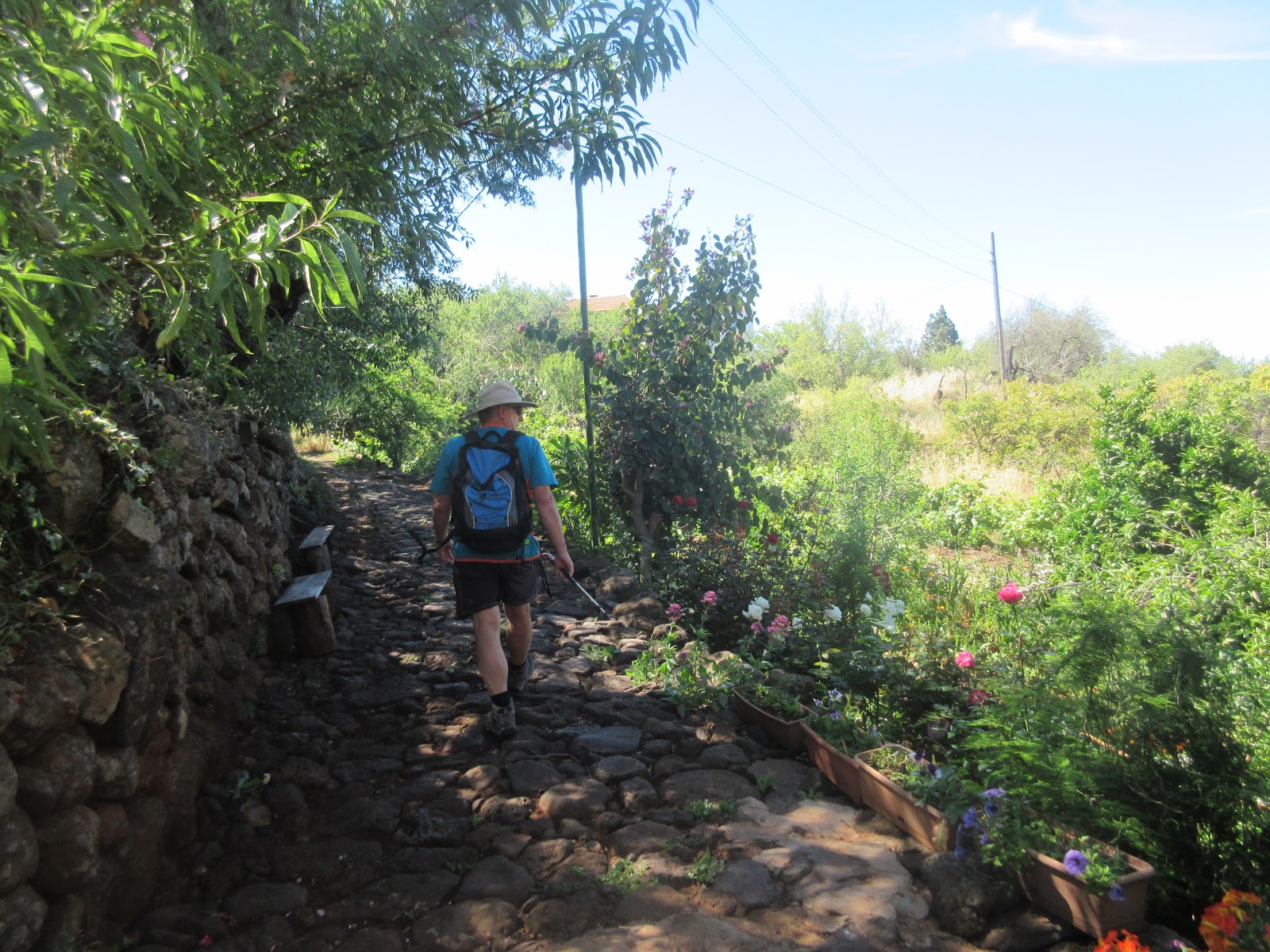
 Now you're on the route proper and can start enjoying the cobbled paths that pass by an interesting selection of old traditional houses, a windmill and the beauty of La Palma's countryside.


Saturday, 4 November 2017

Día de Todos los Santos - All Saints Day

I will be the first to admit that La Palma likes nothing better than a jolly good fiesta. In fact almost anything, noteworthy or not, can have its own special day. For example, La Fiesta del Entierro de la Sardina, the Fiesta of the Funeral of the Sardine. However, fiestas are not to be confused with  religious days, which are often Public Holidays. 
And one of these very special religious days is the  Día de Todos los Santos - All Saints Day - which is held on 1st November. Here on La Palma it is normally called El Dia de los Difuntos, the Day of the Deceased. 
This is a day which is dedicated to remembering, not just the saints, but also those who have gone on before such as relatives, friends and neighbours. There is a saying, 'Nadie más muerto que el olvidado' - Nobody is more dead than the forgotten. And in Spain, they say it with flowers thus making sure nobody is forgotten.

Prior to the day, cemeteries are given a spruce up and flower shops begin the task of trying to make sure there are enough flowers. In the larger towns and cities, people are literally queuing up to buy flowers. But even in smaller places, if you leave buying your flowers until the last moment, they will have run out. 

A rather improbable venue for a celebration, the cemetery, becomes a hive of activity on 01 November, with swathes of people turning up every few minutes with arms full of flowers. At our village in the north of La Palma, groups of cheerful local ladies trim, tweak and tidy the blooms into beautiful arrangements, sprays and posies with which they decorate not just tiered vaults but also the ancient graves. In a jamboree of festive colour, a celebration of life gradually blossoms.
And so, one of the lovely things about the Day of the Deceased is that the cemeteries are not just a place for sadness, but also for happiness and laughter when recalling the good times. There may be sobbing or singing but always there is an over-riding sense of support for each other. It is certainly a bitter-sweet experience of remembering and celebrating all rolled into one.
It really is a question of flower and glory, for ever and ever.
I think we can say Amen to that.

Monday, 19 June 2017

San Andres and Marine Walk to Charco Azul and Puerto Espíndola - Part II

On our way now from the beautiful little village of San Andres to the Puerto de Espíndola, this the second part of our blog post - you can see the first part here: http://holiday-lapalma.blogspot.com.es/2017/03/san-andres-and-marine-walk-to-charco.html
Although the walk is very easy and quite short, there are many things to see along the way and of course even a bit to learn. For example, you'll be able to read from one of the information boards about how the settlement of San Andres was the most important trading centre in the north-east of La Palma, especially in the 16th and 17th century. It's hard to imagine what it was like that far back!
But the tiny port of 'La Cuevita' that is passed along way was doubtless key and you can still see the winch that was used in more recent times to get boats in and out of the water. Before the advent of the fantastic roads we have now, it was

Friday, 19 May 2017

Dolphin Spotting from Tazacorte

Our latest adventure was the very much awaited for boat trip from the Puerto de Tazacorte.
This was the big one on my List of Things to do on La Palma and I can't tell you how long I've waited for this! Well, if pressed, probably 15 years but with a whole lot of other things clamouring for attention, it's only in the last few years that it is has doggedly moved up to pole position. But still held held back by the self-closing doors of time and opportunity.
Until as luck would have it (and with David's family over on holiday) we found ourselves staying at one of the

Saturday, 22 April 2017

Fuencaliente Salt Pans, La Palma,

The Teneguia Salinas Marinas, Salt Pans, of Fuencaliente are well worth a visit if you are in the south of La Palma. Located beyond the small town of Los Canarios, the sight of the salt pans is certainly impressive. It's a place where the white salt is ordered by black lava in a layout almost akin to a chess board. But here, it's the sun and warm wind that do all the moving to turn sea water from the Atlantic Ocean into sought-after salt.
It was in 1967 that the idea was born to create the salt pans, following the concept of salt pans in Lanzarote. Maybe there would be a market for the salt, maybe not. However, only 4 years later in 1971, it seemed that the Teneguia volcano would wipe out the

Tuesday, 21 March 2017

San Andres and marine walk to Charco Azul and Puerto Espindola Part I

For those on holiday staying at the more southerly resorts on La Palma, I can imagine that it might be difficult to tear oneself away to explore the more northerly points of the island. However, for a place that has Canarian charisma oozing out of every cobbled stone and cute cottage, the little village of San Andres in the north east of La Palma is a must.
When we were looking for a place to live on La Palma, we stumbled across San Andres and immediately thought, 'Ah, this is it!' Everything one imagines a Spanish village to be, from the beautiful plaza with church (La Iglesia de San Andrés Apóstol), three cafe/restaurants dotted around the plaza and an abundance of cobbled streets. All in the most beautiful setting overlooking the Atlantic Ocean.
Actually, the church alone is very interesting as this was the site of one of the first churches to be built on the island by the Spanish Conquistadors in 1515. The present church was built in the 17th century. Unlike most churches the entrance is not at the nave end but it has two main doors at the side. Since our first visit there, we haven't been able to go inside the church as it's been locked up, but one of the most surprising things is the selection of doll parts adorning some of the walls. Apparently, this is to pray for people who are ill with the relevant part left in the church.
For walkers, the GR130 Camino Real walking route runs right through San Andres, so that's a bit of a treat in store, an oasis at the end of banana plantations. However, if not passing right through, you'll probably want to walk around the three main streets just so you don't miss anything, including a second little church. One thing you might miss though is the view from the upstairs at Bar Miami in the main street. That's my handy tip for the day :)
Moving right along, follow the GR130 signs towards Los Sauces and this will get you on the marine walk. It's a very enjoyable - and flat - walk which links San Andres to Charco Azul and Puerto Espindola.
Along the way, there is an absolutely lovely wooden bridge, quite new, but of a great design.

Also the old lime kiln which was very important from the days when lime paint was used to coat houses and protect from damp.  You can look right inside the kiln which is fascinating with its curved, brick interior.

Continuing along the marine walk, there's plenty to see, the sea for a start! But also various subtropical plants and a few very interesting houses. I'll let you be the judge on that!

Charco Azul here we come ... to be continued :)

Wednesday, 1 February 2017

Restaurante El Bernegal, Santo Domingo

We were all sad when the Restaurant el Bernegal in Santo Domingo closed a couple of years ago. It was a hugely popular restaurant with a very varied menu which included some great options for vegetarian food. 

Located in a beautiful, old Canarian house with 3 separate dining rooms, it has plenty of charm and character. Add individual dining tables covered with white linen tablecloths, an abundance of sparkling wine glasses at every place setting, hanging plants and Moroccan-esk wall tiles in the charismatic central hall and the ambience is nothing short of suggesting a high class, expensive restaurant. 


Well, you'd almost be right apart from the fact that it's not expensive at all so you can imagine how happy we were to discover that it had reopened last year.
And better still, although with a new owner, the same great chef.
A birthday was the perfect excuse to try it out once more and it's a definite thumbs up from us. But since that seems to be the general consensus of opinion, don't be too surprised if it is packed full on a Sunday. Yes, waiting times might be long so it might be better to go during the week of possible.


Here are the opening times:
Wednesday, Thursday, Sunday - 12.00 to 17.00 hrs
Friday and Saturday - 12.00 to 17.00hrs then 19.00 to 22.00hrs
Closed Monday and Tuesday
To make a reservation, phone 0034 922 40 04 80

Tuesday, 30 August 2016

Cumbrecita and El Paso Visitor Centre

The larger towns on La Palma have a Visitor Centre and this is where you can get maps, leaflets and guide books along with help and information from the staff. Just be aware that they generally close between about 13.00hrs and 16.00hrs. However, if you are looking for information on the Caldera de Taburiente, the Cumbrecita, Volcano Route and the topography, flora and fauna of the island, then the El Paso Visitor Centre is a good place to go and it's open all day.

Happily, it's really easy to find as it's located right next to the LP3 main road which runs between the east and west coasts, just at the 20km marker. This is also where the road goes up to La Cumbrecita. A word of caution - please do observe the speed limits in this area on the LP3!
Where are we? This is where you can find out about the National Park
The Cumbrecita is one of my many favourite jaunts on the island and it gives a great overview of the immense Caldera de Taburiente. Mr. Rother's Walking Guide also likes it quite a lot too so I'm in good company - he says that if you only do one walk on the La Palma, this should be it! And I have to say that I probably agree. You can read our blogpost about the Cumbrecita here.
La Cumbrecita walk
If you are thinking of driving up to the Cumbrecita, then you need to get a ticket from the El Paso Visitor Centre for the car as parking is limited ie, not many cars can get parked because there isn't much space. So it's a bit of a queuing system just like in the supermarket. Sometimes you can go up straight away and at peak times, there could be a long wait. My suggestions is that you ask at the reception when you arrive how long the wait is rather than looking at the exhibits in great detail and then discovering that there is a 40 minute wait before you can go up to to the Cumbrecita. If needs though, there is a bar/cafe directly opposite to while away the time.
My favourite exhibit at the Visitor Centre is the relief map/display of La Palma. I look at it and think, good grief - do we really live there! 'There' is at 500m above sea level, half-way across the north coast in what is the most mountainous region of La Palma. But more importantly it gives you a really fantastic overview of La Palma and just exactly why the roads are so twisty!
 Looking at the information panels, you can also discover how La Palma used to be divided up into the various municipalities. You might notice that there has been a bit of political shuffling round and Tazacorte has now become a municipality in its own right.
If you have time, you might like to wander over to the botanical garden or watch the 20 minute video on La Palma which is available in Spanish, English, German and French.  The Spanish video is on every hour on the hour.  The other languages are on every half-hour. In all cases, go to reception to ask for the video to be played, if not already on. Everything is free by the way.
Also free is the sight of the Old Man of the Mountain. This is not quite the best vantage point from which to view the apparent profile of an old man laying down. However ... to the left in the picture, he is clasping his hands together over his stomach. Looking along to the right, the profile dips down to his neck and then a vertical rise to his chin, lips and nose. The saying is that when the old man rises, then La Palma will disappear beneath the waves.

Opening times:
The Cumbrecita car park and walk is open from 08.30hr to 19.55hrs seven days a week, No toilets or other facilities available by the way.
The El Paso Visitors Centre is open from 09.00 to 18.00hrs seven days a week, toilets are available. Parking is right outside and free. If approaching from Santa Cruz in the east, slow down as you approach 20km and turn into the car park. If approaching from Tazacorte/El Paso/Los Llanos in the west, turn into your right where there is parking on your side of the road opposite the centre. Because it is situated next to the main road, please take care at all times.

Wednesday, 27 July 2016

Swimming around La Palma

There is one thing about an island you can guarantee – there's always plenty of water around! And whilst La Palma is often known as a walking destination, it would be a real shame if it was overlooked as a beach destination as well.
Los Cancajos beach
If you are in the area of Los Cancajos near the capital, the beaches there would certainly get our vote. Here you will find three lovely inter-linking beaches with easy access in and out of the sea, the water is clear and the fish are usually in abundance which also makes it perfect for snorkeling.
Another nearby beach is just 1km south of the capital, the Playa Bajamar. And further up the coast is the Playa Espindola near San Andres - all good, sandy beaches with easy entry.
And of course let's not forget the main beach at Santa Cruz itself, right across the road from the historic mansions. It's not open to the public yet, but hopefully the grand opening is not too far away!
Santa Cruz beach
Over on the west side, a popular beach is at Tazacorte at what you might call Tazacorte village where there is also a great range of apartments and restaurants. It almost never gets crowed although in August it's pretty busy. Tazacorte is often cited as having the most sunshine hours year round in the whole of Europe!
Tazacorte beach, 31 December
Tazacorte beach - August
Not too far down the coast is Puerto Naos, also a popular place for its beach and apartments. Plus it's got a great new promenade now, very swish!
Beach at Puerto Naos
However, another favourite place to swim is La Fajana de Barlovento which is in the North West. It is not too far off the main road, parking is easy and the water is nearby. There is no actual beach but plenty of terraced areas to get laid out in the sun and the facilities are among the best on the island with free, scrupulously clean toilets and showers too.
La Fajana de Barlovento
 In summer, the sea is fantastic for swimming and great for snorkeling. But the sea pools are also surprisingly good. The three pools have something for everyone from small children to keen snorkelers as the main pool is quite large and just over 2 meters deep. The water is again crystal clear and they are all absolutely teeming with fish. And - it is quite an experience to swim in the calm water of the pool.
Sandy cove below Puntagorda
But there are many hidden coves around the island too and if you're a bit of an explorer, then get your map out and - discover! Take a look around Los Canarios in the far south, Puntagorda in the north west, Puntallana in the east, they all have little coves where you can lay on the beach and enjoy a swim in the clear waters of La Palma. Enjoy!

Friday, 10 June 2016

Fiesta of the Sacred Heart, El Paso


Last week, the 5th June, in El Paso was the beautiful fiesta of the Sacred Heart of Jesus. It's one of those fiestas which is not all about party time but more about reflection and celebration. Firmly with a religious base, it's very much worth a visit whether religious or not.

The amazing thing about this annual celebration is the way the decorations are made, an incredibly painstaking labour of love using natural materials and which literally takes months. 

The procession starts from the church of the Conception of Bonanza in the upper part of El Paso and then down into the town. Along the way the streets are decorated with handmade lanterns to light the way, arches and tapestries of flowers and seeds that depict various images. They are all created with natural materials made by different neighbourhoods, groups, associations and individuals and take months to make - and just for this day.
All the various areas of El Paso contribute including El Paso de Abajo, Tajuya, La Rosa, Camino Viejo, Fatima, El Calvario, Tenerra, artists Rodrigo Gonzalez de Paiz and Carlos Afonso, the Red Cross, the Center for Disability Care in Triana and different schools in El Paso.

Tuesday, 31 May 2016

Walking the GR130 Camino Real - Barlovento to Franceses

We are having a great time re-walking our local walks along the GR130! Our latest one is the Barlovento to Franceses route which is a grand tour through nature with some breath-taking views. When it comes to features in a walk such as wooded trails, cliff tops views and emblematic villages, it really does come out tops.
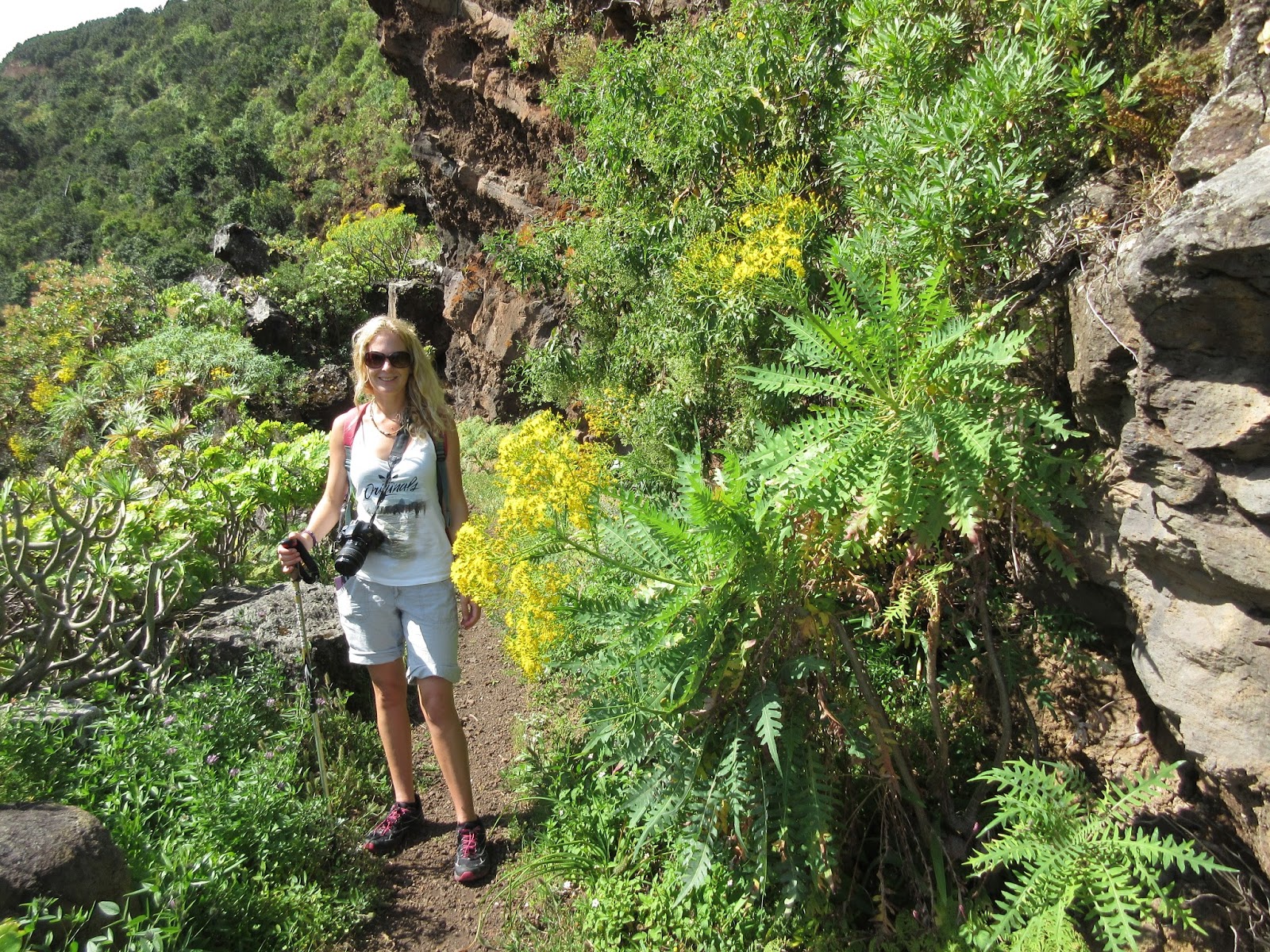
And since this walk is included in our self-guided luggage transported walking itinerary, we kept the walk pure by starting at the Hotel Romantica at the top end of Barlovento town. That way, we can record it faithfully on Endomondo. And with my daughter along for the walk, that's definitely an added bonus! (Just in case you get mixed up, she's the leggy blonde and I'm the er, well not so leggy. Or blonde :)
So having started out from the hotel, it's a pleasure to go through the little wooded walk which brings us out at the top end of town. From there we stride out along the road with calls of 'why are we walking so fast?' It's a long way to go! Since it's a flat road, we don't like to dawdle but the road doesn't last long before we are on what you might call the trail proper.
The first part of this particular walk is, I would say, easy but it's only 30 minutes from the start before we get our first wonderful sea view. This is as we walk by the hamlet of La Tosca and the famous Dragon Trees of La Palma. It's also where the old, stone laundry basins are. The are fed water from one the many natural springs and it's good to imagine a whole gaggle, can I say, of women with their washing. In fact, we've got one of these old laundry basins at our own house in Franceses. I dimly recall thinking that I might 'go native' and use that instead of any automated means. I think that idea lasted about two weeks before I was off to look at Hotpoints and the like!
The laundry basins on the trail are now filled with greenery so obviously the local ladies have caught onto to mod-cons as well.
Then we're off into the wild green wonder with a myriad of exotic plants such as Agave, Stone Crop and the effervescent Sow Thistle. But caves are always fascinating too and although the big one on this section is more of an overhang, there are still remnants of where goats have been kept. You can also very clearly see the different strata in the rock face. But it's all very pretty wherever you look :)
So that's playtime over as we commence with a little barranco. In fact it hardly earns the name of barranco (ravine) because the main ones are much deeper at around 400m deep. Now it's onward and upward, or rather downward and upward into the deep Barranco de Gallegos before we get to the hamlet of La Crucita. In fact, there are only about ten houses here and because we cross the 'village' road almost before the houses have begun, we don't get to see many of them before trekking off down into the next barranco. But this one is very small and  the great thing is that there are some amazing caves to see laid out over three levels. Definitely worth pausing and having a peek inside.
At the top of the slope, we come to our half-way point and the lively village of Gallegos. I say lively because many Venezuelans live there and because it is the largest village across the north. But then again, it can very, very quiet ..... There is a bar/cafe though and it would seem almost rude to pass through without even a nod or better still a cold drink. There is even a little village shop over which the barman presides and he's more than happy to let you have a quick browse if you need any village shop items.
So suitably prepared for the next half, it's down the slope as we go towards the sea. And I think this time, we are walking rather more slowly than the first half - mainly due to the astounding view. We are quite a bit closer to the sea now, although still quite high, so the views really are show-stoppers. It's quite hard to tear ourselves away from the mirador! (lookout point)
Just 20 minutes later, we've reached the bottom of the second barranco and into what we like to call 'Mexican Valley' but what is actually the Barranco de Franceses. We love it because of the huge, smooth stones underfoot that form the ravine bed, the concentrated heat, the stillness and the cactus. Hey – Méhico! Actually, the cactus are Cardon or Candelabra cactus.
And it's not one ravine but two as it's a double dip - rising slightly before dipping down again. Although the rise between the two only takes 15 minutes and I think it's quite a special part of the walk to be enjoyed and not rushed. It's two for the price of one if you like to look at it that way and the rise in the middle is kind of fun. The incongruity of the zig zag path with us only moments apart but on an entirely different level is quite funny. (You might need to study the photo below to understand what I mean.)
Arriving at the base of the ravine on the other side of the rise, this time there is no cactus but a relatively large, flat area of multi-coloured, multi-shaped small stones rather reminiscent of a beach. There's also a craggy overhang which is a great place to enjoy some shade. If we want to get home in time for an afternoon cuppa though, it's time to press on. From here, it's a case of up, up and more up - with many rewards along the way. First a vertical spyhole quickly followed by a mirador complete with stone bench and a horizontal spyhole. Actually that spyhole is an arch of hard stone resting on a dip of softer stone.
It's also a good place to look back and see where you've come from and how far you've walked. There's quite a sense of disbelief as we look towards Barlovento in the distance!
Continuing up the path, there are a few teases by way of some houses dotted about. My suggestion is that you don't let this lead you into thinking you are almost 'there' because you've still got some more uphill work to do. And then when you reach the asphalt road, it's still another 30 minutes back to base, if going all the way to Las Tierras. But first of all you get to walk along the exquisitely narrow village road of Los Machines before entering the last, beautiful dell of Las Tierras, all still part of the stretched out area known as the French Quarter or Franceses.
Was this a good walk? You betcha!
* Our self-guided Luggage Transported walks include:

  • Highly-detailed walking notes (for the Barlovento to Franceses walk, 3 x A4 sheets)
  • Km guide with all walking signs integrated to keep you on track
  • Points of interest to make sure you don't miss salient features
  • Our own walk profile complete with distances and timings
  • History of each town en route

    For more information on Holiday La Palma self-guided walks, take a look at our webpage here:
    http://www.holiday-lapalma.com/luggagetransportedwalking.html
    or Contact us here: ann@holiday-lapalma.com