Join us for a little bit of island life!
Showing posts with label Barlovento. Show all posts

Tuesday, 31 May 2016

Walking the GR130 Camino Real - Barlovento to Franceses

We are having a great time re-walking our local walks along the GR130! Our latest one is the Barlovento to Franceses route which is a grand tour through nature with some breath-taking views. When it comes to features in a walk such as wooded trails, cliff tops views and emblematic villages, it really does come out tops.
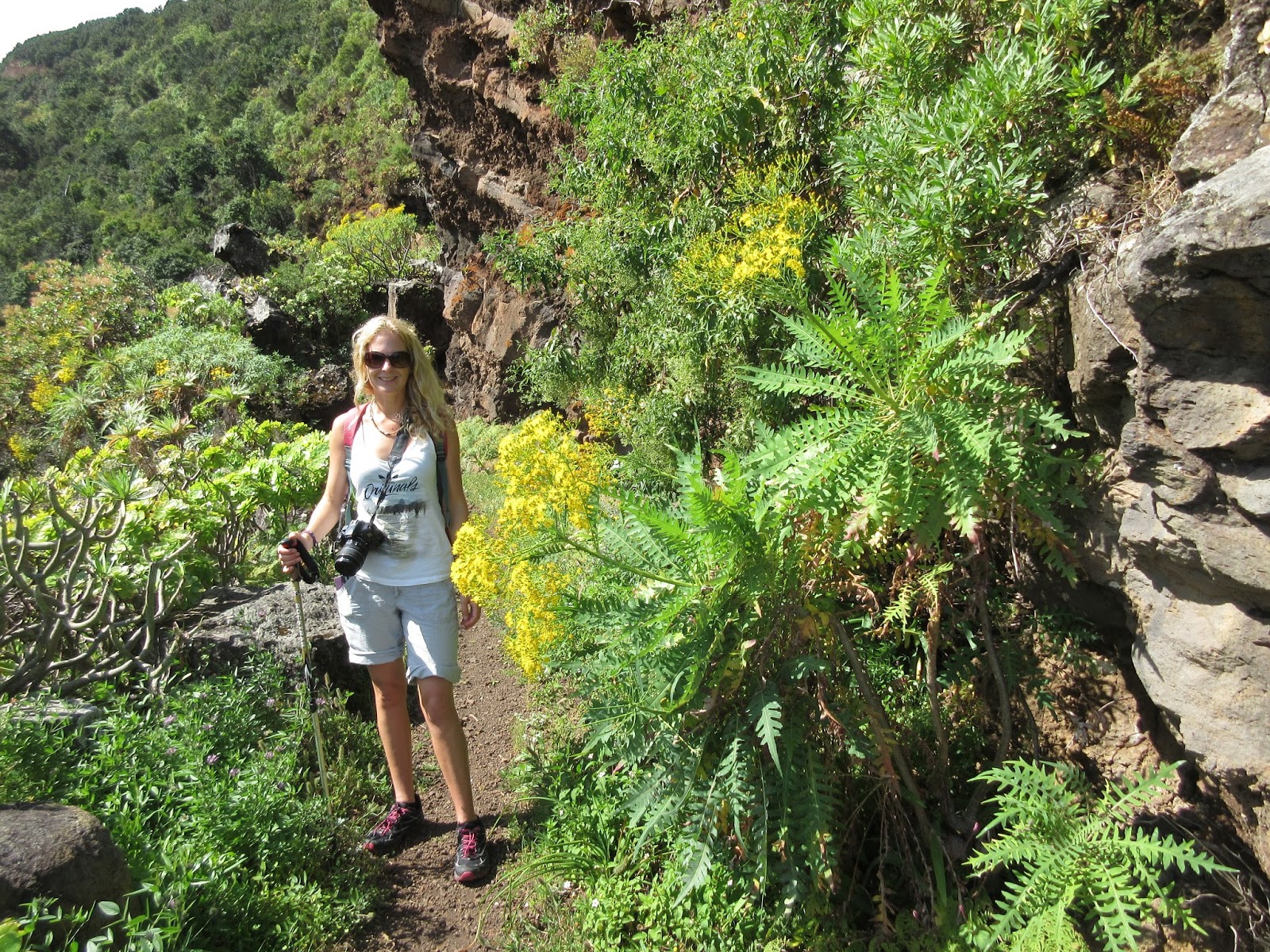
And since this walk is included in our self-guided luggage transported walking itinerary, we kept the walk pure by starting at the Hotel Romantica at the top end of Barlovento town. That way, we can record it faithfully on Endomondo. And with my daughter along for the walk, that's definitely an added bonus! (Just in case you get mixed up, she's the leggy blonde and I'm the er, well not so leggy. Or blonde :)
So having started out from the hotel, it's a pleasure to go through the little wooded walk which brings us out at the top end of town. From there we stride out along the road with calls of 'why are we walking so fast?' It's a long way to go! Since it's a flat road, we don't like to dawdle but the road doesn't last long before we are on what you might call the trail proper.
The first part of this particular walk is, I would say, easy but it's only 30 minutes from the start before we get our first wonderful sea view. This is as we walk by the hamlet of La Tosca and the famous Dragon Trees of La Palma. It's also where the old, stone laundry basins are. The are fed water from one the many natural springs and it's good to imagine a whole gaggle, can I say, of women with their washing. In fact, we've got one of these old laundry basins at our own house in Franceses. I dimly recall thinking that I might 'go native' and use that instead of any automated means. I think that idea lasted about two weeks before I was off to look at Hotpoints and the like!
The laundry basins on the trail are now filled with greenery so obviously the local ladies have caught onto to mod-cons as well.
Then we're off into the wild green wonder with a myriad of exotic plants such as Agave, Stone Crop and the effervescent Sow Thistle. But caves are always fascinating too and although the big one on this section is more of an overhang, there are still remnants of where goats have been kept. You can also very clearly see the different strata in the rock face. But it's all very pretty wherever you look :)
So that's playtime over as we commence with a little barranco. In fact it hardly earns the name of barranco (ravine) because the main ones are much deeper at around 400m deep. Now it's onward and upward, or rather downward and upward into the deep Barranco de Gallegos before we get to the hamlet of La Crucita. In fact, there are only about ten houses here and because we cross the 'village' road almost before the houses have begun, we don't get to see many of them before trekking off down into the next barranco. But this one is very small and  the great thing is that there are some amazing caves to see laid out over three levels. Definitely worth pausing and having a peek inside.
At the top of the slope, we come to our half-way point and the lively village of Gallegos. I say lively because many Venezuelans live there and because it is the largest village across the north. But then again, it can very, very quiet ..... There is a bar/cafe though and it would seem almost rude to pass through without even a nod or better still a cold drink. There is even a little village shop over which the barman presides and he's more than happy to let you have a quick browse if you need any village shop items.
So suitably prepared for the next half, it's down the slope as we go towards the sea. And I think this time, we are walking rather more slowly than the first half - mainly due to the astounding view. We are quite a bit closer to the sea now, although still quite high, so the views really are show-stoppers. It's quite hard to tear ourselves away from the mirador! (lookout point)
Just 20 minutes later, we've reached the bottom of the second barranco and into what we like to call 'Mexican Valley' but what is actually the Barranco de Franceses. We love it because of the huge, smooth stones underfoot that form the ravine bed, the concentrated heat, the stillness and the cactus. Hey – Méhico! Actually, the cactus are Cardon or Candelabra cactus.
And it's not one ravine but two as it's a double dip - rising slightly before dipping down again. Although the rise between the two only takes 15 minutes and I think it's quite a special part of the walk to be enjoyed and not rushed. It's two for the price of one if you like to look at it that way and the rise in the middle is kind of fun. The incongruity of the zig zag path with us only moments apart but on an entirely different level is quite funny. (You might need to study the photo below to understand what I mean.)
Arriving at the base of the ravine on the other side of the rise, this time there is no cactus but a relatively large, flat area of multi-coloured, multi-shaped small stones rather reminiscent of a beach. There's also a craggy overhang which is a great place to enjoy some shade. If we want to get home in time for an afternoon cuppa though, it's time to press on. From here, it's a case of up, up and more up - with many rewards along the way. First a vertical spyhole quickly followed by a mirador complete with stone bench and a horizontal spyhole. Actually that spyhole is an arch of hard stone resting on a dip of softer stone.
It's also a good place to look back and see where you've come from and how far you've walked. There's quite a sense of disbelief as we look towards Barlovento in the distance!
Continuing up the path, there are a few teases by way of some houses dotted about. My suggestion is that you don't let this lead you into thinking you are almost 'there' because you've still got some more uphill work to do. And then when you reach the asphalt road, it's still another 30 minutes back to base, if going all the way to Las Tierras. But first of all you get to walk along the exquisitely narrow village road of Los Machines before entering the last, beautiful dell of Las Tierras, all still part of the stretched out area known as the French Quarter or Franceses.
Was this a good walk? You betcha!
* Our self-guided Luggage Transported walks include:

  • Highly-detailed walking notes (for the Barlovento to Franceses walk, 3 x A4 sheets)
  • Km guide with all walking signs integrated to keep you on track
  • Points of interest to make sure you don't miss salient features
  • Our own walk profile complete with distances and timings
  • History of each town en route

    For more information on Holiday La Palma self-guided walks, take a look at our webpage here:
    http://www.holiday-lapalma.com/luggagetransportedwalking.html
    or Contact us here: ann@holiday-lapalma.com

Tuesday, 2 February 2016

Walking Los Tilos to Barlovento

How are you doing with your New Year resolutions? I hope they will include a holiday to La Palma at some point!
One of our aims for 2016 is to make sure we re-walk the 6 routes included in our Luggage Transported Walking Holidays. And after we've done that, then we'll walk the rest of the GR130 Camino Real as we continue to build on our range of walking holidays for the winter season of 2016/7.
First up then is the Laurisilva Forest of Los Tilos walk through to Barlovento. At under 4 hours, it's a gentle introduction on what is the first day of the walking holiday - although admittedly an immediate ascent for the first 40 minutes of the walk up the forested track :)
It is however one of these walks where it pays to know what you are looking at and happily the walk starts at the Visitor and Information Centre of Los Tilos. This is where you can read about the Laurisilva which is a species from the Tertiary period when dinosaurs roamed the land.
(For those of you on our luggage transported walking holiday, we provide extensive information about the walk and the route for you to read beforehand so you can do some advance reading.)

Los Tilos Visitor Centre
From the centre then, it's onward and upward to the Mirador de los Barandas on the PR LP7.1 walking route. And let's just remind ourselves, it's not a sprint but rather more a chance to use our new found knowledge about the flora and fauna of Los Tilos :)

At the top of the woodland steps, we come to the Mirador (look-out point). The last time we walked this, there were picnic tables and benches but these have been dismantled for the moment. The view is pretty good over the town of Los Sauces, of the bridge (the longest single-arch bridge in the Canaries) and to the sea.
From the mirador it's an easy stroll along the forest track - no need for heroics! Definitely a good photo opportunity when you come to the giant ferns and the mountain view. Then a question of logistics as to how to negotiate a fallen tree - over, under or through? And the intriguing caves cut into the soft rock which the workman have used in the past. Always good to take a sneaky peak inside ...

But then we come to my favourite part which is the water mine - if you're not expecting it, it's quite a surprise to come across rail tracks in the wood along with the little cart which was used to carry the rock out of the tunnel. Although the over-riding feeling is astonishment at man's endeavour to reach the source of fresh water.
I'm not going to tell you it all of course because I don't want to spoil a good story. So still with the La Laguna reservoir to talk about, I'll just leave you with one last photo -


Tuesday, 17 March 2015

Sea of Clouds

The weather on La Palma can be many things - and often at the same time around different parts of the island. In fact, when guests arrive here at the finca either at the cottage accommodation or bed and breakfast, they often ask, 'Is it always like this?' And that is no matter what the weather is doing. The answer to the question is, 'It's never always like anything'. (Incidentally though, if I may take the opportunity to mention it, that is the title of our book out on Kindle later this year - Is it Always Like This? And you might be relieved to hear, it's not just about the weather on La Palma but about our journey which led us to come and live on a finca in the most rural part of one of the smaller and less well-known islands in the Canaries and, yes, fun on the finca.)
But talking of weather, last week we enjoyed a particularly hot spell even at daybreak with the air like a pleasantly warm bath.
And this early morning warm air induced a phenomena known in the Canary Islands as El Mar de Nubes, The Sea of Clouds.

The photo above was taken from our car park area right here on the finca in Franceses, looking westward towards Santo Domingo de Garafia. The time was 07.25 in the morning - what an amazing spectacle to wake up to.
And this photo was taken a couple of minutes later looking eastwards towards Barlovento.
La Palma never ceases to amaze me.

Wednesday, 17 July 2013

El Faro del Punta Cumplida, Barlovento

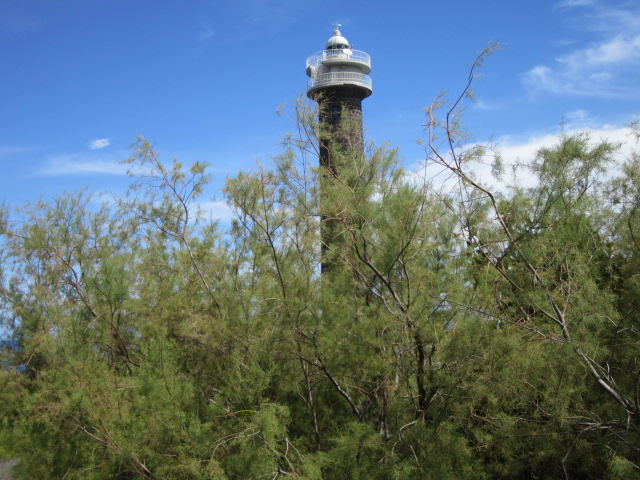
If you are a subscriber to our newsletters, you may have read that we recently visited the Faro (lighthouse) of the Punta Cumplida near Barlovento.
To be honest, it was just a little excursion while on the way to the sea pools of La Fajana which are nearby and in the hope that somehow, something might have changed. The thing is that whilst this is a potentially interesting place - after all, it's one of only two lighthouses on the whole island of La Palma - there is absolutely no chance of being allowed inside - still. In fact, you're not even allowed in the grounds. None the less, it is still worth the small detour and at least there is an information board which does give you a flavour of what it's all about.
  The lighthouse is historically important and dates back to before 1867. The base was built from local stone whilst the stone for the tower was brought by ship from Gran Canaria. Don't ask me how they did it! Unsurprisingly it cost a lot of money - 758€ which must have been a complete fortune in those days. 
One of the features of the tower is the number of windows, 12 in all, with 6 facing toward the sea and 6 facing inland. If you like facts and figures, you may be interested to know that there are 175 steps and that the tower measures 6.8m in width and 33.16m in height. 
During the 130 years of service, records were meticulously taken and many of these survive today including minutes of meetings, the maintenance diary, information on operational staff, the amount of oil and electricity consumed, communications and movements in and out of the storeroom. Unfortunately of course, there was no chance to see any of those however, it was still very interesting to spend time exploring the near vicinity and we discovered a new picnic area/lookout point that we hadn't seen before.
Imagine my surprise then when I found out that we were to be able to have a very good look at the most important part of the lighthouse - the light itself and from a place rather more accessible.
We had noticed that in Barlovento opposite the little tourist office that there was a metal frame being constructed but had no idea what it was about. The following week I discovered with amazement that the frame was to house the light from the lighthouse! This was definitely worth stopping off to see.
So anytime you are driving through Barlovento, I suggest you stop and have a look. It's a fabulous piece of equipment and a real treasure for us all to admire.
Of course you are probably wondering if there is any form of light in the lighthouse at all. I now read on Wikipedia that in August 2011, El Faro del Punta Cumplida became the first lighthouse in Europe to have a high power LED light and that the new system consists of a hexagonal matrix of six panels with four LED lamps in each giving a light intensity of 505,000 candles. Thank you Wiki. 
So there you have the story of El Faro del Punta Cumplida! 

Tuesday, 28 May 2013

Which is the best month in the Canaries?

When people ask which is our favourite month on La Palma, it's always difficult to answer. Each month and season has something special to recommend it!
Spring is of course fabulous for the wild flowers - great bundles of sweet peas that line the donkey paths and always in the vibrant colours of hot pink and stunning magenta, terraces blanketed in purple and yellow and bright red poppies springing up wherever they get the notion.  But then winter is pretty great - after all, the winter sun is what a lot of people come to the Canaries for. Summer is lovely with long days in the garden, swimming or beach combing down at our local beach of La Fajana de Garafia just a 12 minute drive away and the nightly chorus of crickets and frogs.  And autumn is also beautiful with the colours as the chestnut tree leaves turn to amber and we are picking baskets full of figs from the trees on the finca.
We have a special reason the look forward to May though because this month heralds the start of when we get both a sunrise and a sunset from the finca. Crazy I know!  
Here's a photo of our lovely sunrise as we look east towards Barlovento.
A sunrise is definitely worth getting out of bed for and is so inspirational. And of course for those who are planning a long walk, then an early start during summer is usually advisable - great to have bed and breakfast accommodation right by the GR130 walking route in that case!
And then in the evening, we can enjoy the sunset. And that's the great thing about sunsets, you never know if it's going to be fiery and fill the sky with the intense glow of a volcano erupting.
Or gracefully slip down in the sea.
Whichever theme it chooses, it's always a magic sight.
And to think that when we came to live here in Garafia in the north of La Palma, we didn't knkow if we would see either the sunrise or sunset at all. You can read the story about it on our 'Relocating to the Canaries' here.

Sunday, 20 November 2011

Keeping your hat on

La Fajana (pronounced Fahana) is rather a popular name here on La Palma and if you study the map you will doubtless notice several La Fajanas laid about.  In fact, we have two near us – La Fajana de Garafia which is the little port village and beach just below the finca in Franceses and La Fajana de Barlovento which is located by the sea between the towns of Los Sauces and Barlovento. 
So whilst they might share the same name, they are certainly different places with La Fajana de Garafia being our favourite spot for beach-combing, picnics, a walk and a swim or snorkel when the sea is calm and La Fajana de Barlovento our favourite for swimming, snorkeling or even just stopping off for a coffee or light lunch. 
So what can you expect to find there?  Well, the main attraction is the sea pools.  There are various sets of well-made steps that lead down from the car park to the pools and from there you have your choice – a shallow pool complete with handrails which is great for children and those not keen on getting out of their depth, a second pool which is a little deeper and at the side has an intermittent waterfall you can walk under and a third, large pool which is around 3.5m deep in places and also has an intermittent waterfall you can swim under and get a back massage at the same time.  All three pools are beautifully clear and teeming, yes teeming, with multi-coloured fish and whilst we have been SCUBA diving in the pools, you can enjoy seeing the fish by snorkeling too.
The facilities are excellent too and arguably the best on the island.  The toilet and changing block is completely free and every time we have visited, and that is often, they have been impeccably clean.  Outside there are a couple of showers which operate with a 50c coin. 
There is also a very small swimming pool for the disabled or elderly with a seat lift, although I can’t promise that the seat always functions (or there is water in the pool).  And as yet, there is no wheelchair access down to the pools.
But once down the steps to the pools, there are lots of flat spaces where you can lay out in the sun. Picnics are not allowed at all but a little further along from the swimming and sunbathing terraces, there are two bar/restaurants.  
Confident swimmers might also like to take the opportunity to swim in the sea during the summer months when a ladder is provided for access.  Always use careful judgement though as the sea can be rough at times and be aware that there is no life guard.   If you do decide to go in the sea, it’s a different experience altogether and the underwater topography is absolutely outstanding - and beautiful!
Conditions permitting then, there is  no excuse not to strip off and leap in - although of course you can always keep your hat on.  

Wednesday, 9 February 2011

Restaurant Campesino, Barlovento

Family meals at home, fiestas in public plazas, bbq's in the woods and restaurant dining are all the food of life to Palmerans.  In fact, there is a saying here which goes along the lines of,  'We shall have a fiesta - but first we must eat and drink!'   So you can imagine the buzz of excitement when a new restaurant starts up and it was hardly suprising to see a gathering of cars around the newly opened 'El Campesino' restaurant in Barlovento.
Actually, El Campesino opened a few years back as a brand new restaurant, appeared to do well, built a conservatory extension - then closed.  I don't know why but it was certainly a shame.  It then sat empty for several years so we were especially pleased to see it open again last week.  Needless to say, we took little pursuasion to eat there and whilst the photo appears to show a deserted restaurant, it was in fact quite busy out of shot.
I hope you get the opportunity to enjoy a meal there - we certainly enjoyed ours!

Friday, 14 January 2011

Taking the high road

'Aren't the roads good!' is a comment made by many guests. Well, yes they certainly are ... but they weren't always like that.
This section of the LP1, which is the main road running right round La Palma, is near Llano Negro, Garafia, and is particularly wide and straight.  Most of it the roads on La Palma are substantially narrower and twistier than this - however the lack of traffic is completely normal!
The 'original' LP1 in the north is the road that runs straight on in Barlovento and, after squeezing through three narrow tunnels and some pretty impressive scenery, arrives at La Cruce some 35 minutes later. Goatherds are a common sight.

 It is one of the most beautiful drives on La Palma and a 'must do.'  If nothing else, you should drive through the tunnels which were dug with hand tools, just wide enough for the little old bus to get through.  Because it really is the 'high road' it can sometimes be in cloud, so make sure you have a clear day for your trip because, whilst it has its own appeal driving in ethereal clouds, you will miss the spectacular views.

 However, while it was a huge improvement, the road did not go anywhere near Franceses.  Our neighbour told us that  people used to have to make the one-hour walk up to this road to catch the bus - now it runs through the village.

You can still find some stretches of the road previous to that.  There is one we often take visitors on, just behind La Mata.

 Or there is one just by a house next to the petrol station of San Antonio.  It is good to walk on foot or drive in a 4 x 4, but not suitable for cars (hire cars are not insured for off-road tracks).  No wonder that it used to take 4 hours or more to drive to the capital.

Wednesday, 13 August 2008

The Battle of Lepanto


Every 3 years, Barlovento in the north west of the island stages the re-enactment of the naval Battle of Lepanto. It is a spectacle which is the highlight of the two week fiesta held between 31st July and 15th August in honour of Nuestra Señora del Rosario, our Lady of the Rosary, the patron saint of Barlovento. In fact, the re-enactment of the battle of Lepanto (Italian name of the Greek port from where the Ottomans had their naval base) which happened in 1571, is a great tradition in Barlovento and is the only place in the Canaries to celebrate it and therefore a claim to fame for the town.
The Battle of Lepanto between the Holy League (which comprised the Knights of Malta, Spain, the Papal States, republic of Genoa, the Duchy of Savoy, the republic of Venice and others) and the main fleet of the Ottoman war galleys gave control to the Holy League over the Mediterranean and prevented the Ottomans from entering Europe. It was fought solely from rowing vessels (around 500 in total), involved around 23,000 dead, wounded or captured, 10,000 Christian slaves released and, according to some historians, was one of the world’s most decisive battles since 31 BC.
The Holy League credited the victory to the Virgin Mary to whose intercession with God they had implored for victory through the use of the Rosary. A new feast day was instituted which is now called the feast of Our Lady of the Rosary and this is why Barlovento has the honour to represent it.
The spectacle started with Our Lady of The Rosary being carried from the church in all her glory and prayers being said. We then watched transfixed, if one can be for an hour, as the Christians slowly swayed themselves and their boat across the surrounding fields of Barlovento. The Moors meanwhile, protecting their castle on the far hill, squabbled amongst themselves either out of boredom, historical accuracy or an attempt to entertain the crowds, which I must say, it did. The Christians eventually arrived at the castle in their boat which sported impressively large sails and was surrounded by several Turk boats. Following the 'sinking' of a couple of the boats, an vigorous and 'bloody' battle then ensued along with numerous explosions which literally threw the soil into the air creating large dust clouds.
Eventually, after having leapt up several times, the Moors were conquered, taken as prisoner and dragged off to the church to be converted to Catholicism.
Well done Barlovento and all who took part. It was an impressive performance and followed – of course – by much music and merriment far into the night.
For more photos check out http://www.photobox.co.uk/album/60703095