Join us for a little bit of island life!
Showing posts with label Franceses. Show all posts

Tuesday, 31 May 2016

Walking the GR130 Camino Real - Barlovento to Franceses

We are having a great time re-walking our local walks along the GR130! Our latest one is the Barlovento to Franceses route which is a grand tour through nature with some breath-taking views. When it comes to features in a walk such as wooded trails, cliff tops views and emblematic villages, it really does come out tops.
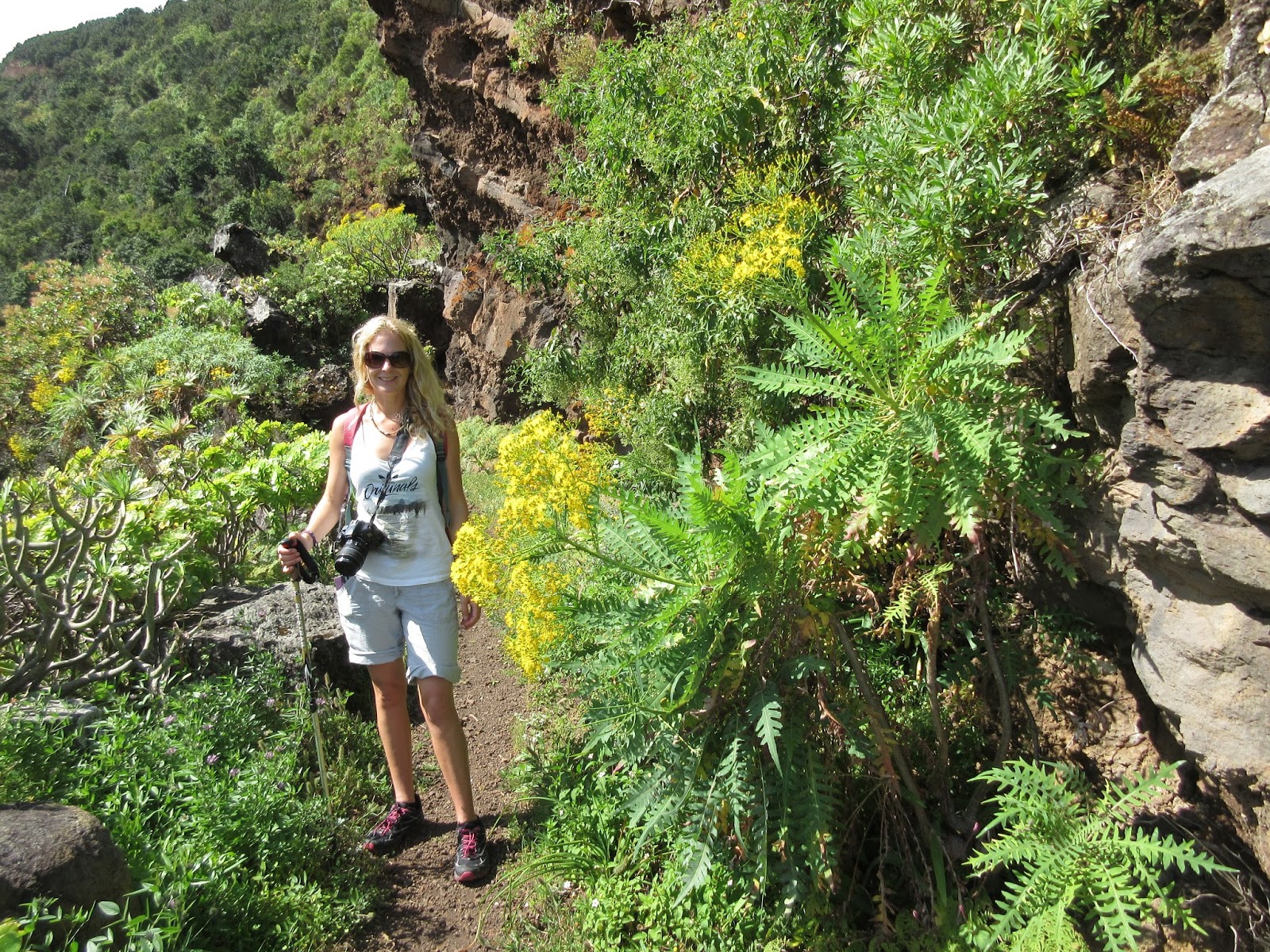
And since this walk is included in our self-guided luggage transported walking itinerary, we kept the walk pure by starting at the Hotel Romantica at the top end of Barlovento town. That way, we can record it faithfully on Endomondo. And with my daughter along for the walk, that's definitely an added bonus! (Just in case you get mixed up, she's the leggy blonde and I'm the er, well not so leggy. Or blonde :)
So having started out from the hotel, it's a pleasure to go through the little wooded walk which brings us out at the top end of town. From there we stride out along the road with calls of 'why are we walking so fast?' It's a long way to go! Since it's a flat road, we don't like to dawdle but the road doesn't last long before we are on what you might call the trail proper.
The first part of this particular walk is, I would say, easy but it's only 30 minutes from the start before we get our first wonderful sea view. This is as we walk by the hamlet of La Tosca and the famous Dragon Trees of La Palma. It's also where the old, stone laundry basins are. The are fed water from one the many natural springs and it's good to imagine a whole gaggle, can I say, of women with their washing. In fact, we've got one of these old laundry basins at our own house in Franceses. I dimly recall thinking that I might 'go native' and use that instead of any automated means. I think that idea lasted about two weeks before I was off to look at Hotpoints and the like!
The laundry basins on the trail are now filled with greenery so obviously the local ladies have caught onto to mod-cons as well.
Then we're off into the wild green wonder with a myriad of exotic plants such as Agave, Stone Crop and the effervescent Sow Thistle. But caves are always fascinating too and although the big one on this section is more of an overhang, there are still remnants of where goats have been kept. You can also very clearly see the different strata in the rock face. But it's all very pretty wherever you look :)
So that's playtime over as we commence with a little barranco. In fact it hardly earns the name of barranco (ravine) because the main ones are much deeper at around 400m deep. Now it's onward and upward, or rather downward and upward into the deep Barranco de Gallegos before we get to the hamlet of La Crucita. In fact, there are only about ten houses here and because we cross the 'village' road almost before the houses have begun, we don't get to see many of them before trekking off down into the next barranco. But this one is very small and  the great thing is that there are some amazing caves to see laid out over three levels. Definitely worth pausing and having a peek inside.
At the top of the slope, we come to our half-way point and the lively village of Gallegos. I say lively because many Venezuelans live there and because it is the largest village across the north. But then again, it can very, very quiet ..... There is a bar/cafe though and it would seem almost rude to pass through without even a nod or better still a cold drink. There is even a little village shop over which the barman presides and he's more than happy to let you have a quick browse if you need any village shop items.
So suitably prepared for the next half, it's down the slope as we go towards the sea. And I think this time, we are walking rather more slowly than the first half - mainly due to the astounding view. We are quite a bit closer to the sea now, although still quite high, so the views really are show-stoppers. It's quite hard to tear ourselves away from the mirador! (lookout point)
Just 20 minutes later, we've reached the bottom of the second barranco and into what we like to call 'Mexican Valley' but what is actually the Barranco de Franceses. We love it because of the huge, smooth stones underfoot that form the ravine bed, the concentrated heat, the stillness and the cactus. Hey – Méhico! Actually, the cactus are Cardon or Candelabra cactus.
And it's not one ravine but two as it's a double dip - rising slightly before dipping down again. Although the rise between the two only takes 15 minutes and I think it's quite a special part of the walk to be enjoyed and not rushed. It's two for the price of one if you like to look at it that way and the rise in the middle is kind of fun. The incongruity of the zig zag path with us only moments apart but on an entirely different level is quite funny. (You might need to study the photo below to understand what I mean.)
Arriving at the base of the ravine on the other side of the rise, this time there is no cactus but a relatively large, flat area of multi-coloured, multi-shaped small stones rather reminiscent of a beach. There's also a craggy overhang which is a great place to enjoy some shade. If we want to get home in time for an afternoon cuppa though, it's time to press on. From here, it's a case of up, up and more up - with many rewards along the way. First a vertical spyhole quickly followed by a mirador complete with stone bench and a horizontal spyhole. Actually that spyhole is an arch of hard stone resting on a dip of softer stone.
It's also a good place to look back and see where you've come from and how far you've walked. There's quite a sense of disbelief as we look towards Barlovento in the distance!
Continuing up the path, there are a few teases by way of some houses dotted about. My suggestion is that you don't let this lead you into thinking you are almost 'there' because you've still got some more uphill work to do. And then when you reach the asphalt road, it's still another 30 minutes back to base, if going all the way to Las Tierras. But first of all you get to walk along the exquisitely narrow village road of Los Machines before entering the last, beautiful dell of Las Tierras, all still part of the stretched out area known as the French Quarter or Franceses.
Was this a good walk? You betcha!
* Our self-guided Luggage Transported walks include:

  • Highly-detailed walking notes (for the Barlovento to Franceses walk, 3 x A4 sheets)
  • Km guide with all walking signs integrated to keep you on track
  • Points of interest to make sure you don't miss salient features
  • Our own walk profile complete with distances and timings
  • History of each town en route

    For more information on Holiday La Palma self-guided walks, take a look at our webpage here:
    http://www.holiday-lapalma.com/luggagetransportedwalking.html
    or Contact us here: ann@holiday-lapalma.com

Thursday, 22 May 2014

Miradors of La Palma

A mirador is a look-out point, 'mirar' being the Spanish verb for to look. If you come on holiday to La Palma, you'll learn that word pretty quickly are there are plenty of miradors from where you can look at the wonderful scenery.
For example, in the north east of La Palma there is the Mirador La Tosca which has a view right the way across the north coast of La Palma, Franceses is right in the middle!
Mirador La Tosca
Another stunning one is the Mirador El Time which is is located just above Los Llanos where the GR131 trekking route crosses the road. The Restaurant El Time is located there so you can eat and drink with a view or alternatively just park in the nearby car park.
Mirador El Time
The Mirador La Montaña is at La Galga between Puntallana and Los Sauces - it's also great for observing the skies. If astronomy is not your major subject, there's a lot of help in the way of information boards!
Mirador La Montaña at La Galga

A little-known mirador on la Palma (mainly because there is no sign) is one which overlooks La Fajana de Garafia approximately 400 metres below. Stunning!
Mirador Franceses
But there are plenty of other miradors - I wouldn't like to hazard a guess how many there are really! So while you're on holiday on La Palma, keep a look out for the look outs and don't forget your camera.
And I'll probably be adding to this blog post so do pop back from time to time!

Monday, 30 April 2012

A cultural holiday on La Palma

‘La Palma is an island of contrasts’ is a phrase that many people (including me) use to try and describe what an amazing island La Palma is. Yep, it’s got it all from forests to beaches, to lava fields, gorges and more besides. So nature has pretty much got all angles covered!
But what about man's attempts? The buildings and architecture?  Well of course you won’t be surprised to hear that on La Palma you can find everything from historic mansions to humble cave dwellings.
Some of the best examples of architecture are in the historic capital of Santa Cruz de la Palma where the main street is literally lined with fascinating buildings, many dating from the 16th century. There the Town Hall for example, whose facade was built in the 1560's, is not only a beautiful building but also happens to be the most important Renaissance buildings in the Canary Islands.
Town Hall in Santa Cruz de La Palma
But not everybody on the island was rich – far from it.  In the rural north of La Palma people lived in caves until relatively recently and even sixty years ago, caves were being lived in as a permanent residence rather than just a weekend retreat. If you take a walk along the GR130 Camino Real, the old donkey trail around the island, it's not hard to spot the caves that dot the hillsides. In one place at least, they are stacked on top of each other.
Caves of the north
Of course, there are many points in between caves and mansions. Again, in the north and following on from caves, were the small stone dwellings with a wooden roof. Later came what are now known as traditional Canarian houses with two-foot thick walls, built into the hillside and with the hip design of roof, or 'cuatro aguas' (four waters) so called because of their four sides. The first roofs of this design had clay Arabic roof tiles which were formed, as the story has it, on the thigh. Later the tiles were from France, flat in design and literally tied onto the roof laths.
Clay Arabic tiles far right, French tiles centre near
In recent years, with a sense of humour never far away, La Palma has livened things up a little.
For anybody with an interest in the history of La Palma, then we are pleased to offer a three-centre cultural holiday to include visits to museums, churches and other places of special interest.
Enjoy!

Monday, 21 February 2011

La Fajana de Garafia - Part I

La Fajana, (pronounced Fahana) is a popular place name on La Palma and it is always a good idea to make sure you know which La Fajana is being referred to. But La Fajana de Garafia is one of my favourite places which is pretty handy as it is only a twelve minute drive away from here in Franceses.  It amazes me on so many levels and, in an attempt to explain the place, it is what many writers would probably call improbable.
The adventure starts with the drive down to La Fajana - but first you need to find the little wooden sign to it.  Actually, it is located just opposite the village shop ... but then the village shop doesn't have a sign to say that it is a shop and so if it closed, it looks just like any other house.  Ah La Palma, we love you!
But once on the road to La Fajana it is all plain sailing with plenty of tacking this way and that as you navigate the car down the winding way.  Remember to watch out for cars coming the other way though along with rockfalls and the occasional walker on the GR130 walking route which crosses the road in a couple of places.
After ten minutes of driving down what some people regard as the edge of the world (actually it is not nearly as dramatic as that and only a case of driving down the side of a ravine), you will eventually come to a place where the land meets the sea.  Almost.  This is the tiny hamlet and port village of La Fajana.
Most likely you will have been expecting to find something quite substantial to warrant any type of road to it at all but instead you will find one of the shortests streets of houses on the island.  In fact, only eleven people live there.  Strolling along the length of the street which takes all of two minutes you may not notice some of the best things tucked away almost out of sight - a bakery, an old wine press, a couple of cows and the little plaza.  It's a place in which to take your time so make sure your speed dial is set to saunter.  And you never know - you might even see a person!
At the end of the street, the track disappears away into the bananas and the distance.  However, a sharp right turn will lead you through the plantation where you can look at the bananas fact to face.  
As you wend your way down this recently restored path and turn a corner, you realise that so far you have been surrounded by silence but now there is the sudden sound of the sea, a certain freshness in the air and a sense of  excitment.  And in a few moments you will actually get to see what the fuss is all about as the clear waters of the mighty Atlantic greet you.  
  
These days, stone steps and sturdy wooden handrails lead you down on to the beach.  Sometimes it is a sand beach, sometimes sand and stones and sometime just stone. Whatever the case, it is there for all to enjoy.
Ah yes, I didn't mention La Fajana Part II yet, did I?

Friday, 14 January 2011

Taking the high road

'Aren't the roads good!' is a comment made by many guests. Well, yes they certainly are ... but they weren't always like that.
This section of the LP1, which is the main road running right round La Palma, is near Llano Negro, Garafia, and is particularly wide and straight.  Most of it the roads on La Palma are substantially narrower and twistier than this - however the lack of traffic is completely normal!
The 'original' LP1 in the north is the road that runs straight on in Barlovento and, after squeezing through three narrow tunnels and some pretty impressive scenery, arrives at La Cruce some 35 minutes later. Goatherds are a common sight.

 It is one of the most beautiful drives on La Palma and a 'must do.'  If nothing else, you should drive through the tunnels which were dug with hand tools, just wide enough for the little old bus to get through.  Because it really is the 'high road' it can sometimes be in cloud, so make sure you have a clear day for your trip because, whilst it has its own appeal driving in ethereal clouds, you will miss the spectacular views.

 However, while it was a huge improvement, the road did not go anywhere near Franceses.  Our neighbour told us that  people used to have to make the one-hour walk up to this road to catch the bus - now it runs through the village.

You can still find some stretches of the road previous to that.  There is one we often take visitors on, just behind La Mata.

 Or there is one just by a house next to the petrol station of San Antonio.  It is good to walk on foot or drive in a 4 x 4, but not suitable for cars (hire cars are not insured for off-road tracks).  No wonder that it used to take 4 hours or more to drive to the capital.

Wednesday, 29 December 2010

A Nativity Scene

Christmas time can bring excitement for many reasons and on La Palma, one of those is the nativity scene, or  Belenes, as they are called.  They are a real work of art and each village, town or area take it upon themselves to bring this little piece of magic to us. Just by looking at them, apart from the religious significance, you can tell that the people who made them had a lot of fun doing it. Often they are in a church hall and are a landscape complete with tiny Canarian houses (with pebbles on the roofs to represent the stones that people really do put on their roofs), goats and chickens grazing nearby, water tanks, crops in the field and of course somewhere in among it all, the nativity scene itself.
Or maybe, out in the country such as the road going down to Santo Domingo, the scene is helped along by a group of small Canarian houses tightly clutching the hillside (think gnomes in a garden).
In Franceses our local people go for the life-size version set in a cave which lies between Los Castros and Los Machines (two areas of Franceses).  
Attention to detail is not spared and old artifacts are casually laid about to add interest.  Here you can see a horse's saddle behind Mary and in the photo below, you can see old implements such as the machete in a chopping block of wood and even a very worn beret as worn by the elderly French residents of the village.
The people who create this scene each year always make it a fun event and cook up a huge paella to reward the work.  But the effort is certainly not wasted and people often stop in their cars to admire the results.   I just love the angel dangling dangerously from the ceiling!  However, from the photos, it's hard to get a sense of perspective until you put a person in front of them!
It has long been our desire to create a nativity scene ourselves, although on a miniature scale as I don't think I could cope with three 6-foot kings about the place.  We have had a couple of attempts over the years but seem to have lost a few components along the way and it has never come to much.  But we do have the very place for it in our own tiny cave just by the sala.
So this year we decided that we would renew our efforts, in a small way. Actually, it's very easy because many of the shops sell figures and little stable-like items or animals just for this purpose.  The only problem is that you can end up with a donkey bigger than a house and the stable so small that baby Jesus won't fit in.
Hopefully this time we have got the scales about right and not only did we enjoy making this little scene, but we are ridiculously proud of it!

Thursday, 9 September 2010

The micro

One of the things that I love most about Los Machines in Franceses is the width of the street because it is definitely of the single track variety.  If you time it right, you will spot the bus squeezing through.  The locals don't call it the 'bus' though, nor the 'guagua' but the 'micro.'  Of course, it was all built long before cars - and heaven forbid, buses - were even considered as a mode of transport in the north.  If a couple of fully-laden donkeys could pass each other, then there was enough room.
But the bus service here is surprisingly good with a two-hourly service throughout the day beginning at 6 am and finishing at 8.30 pm (weekdays).  This is vastly improved from the previous service of only three buses a day.   Nowadays, we use the bus service quite frequently to either take us to a start point for a walk or to take us back to the car or home.  
And whilst there are bus stops across the north, the micro will happily stop for you anywhere providing that you are standing in a place safe for it to stop and that he sees you.  Make sure you raise your hand and, if in doubt, jump up and down too!

Saturday, 28 August 2010

Smuggler's Cove

A couple of weeks ago, whilst overlooking the spectacular Barranco Fagundo from the mirador/restaurant at El Tablado, we noticed that the beach at the mouth of the ravine was sand-covered and looking rather delicious.  Naturally, our curiosity was aroused as this is one beach we have never been to.  Yes, Smugglers' Cove as once frequented by pirates.  So, yesterday, after a one hour walk down the side of the ravine, we arrived at the rocky bottom and set off to explore down towards the sea.
We weren't quite sure how long it would take to arrive at the sea because the bed of the ravine was full of little curves and so it was not possible to see to the end until we were almost there.  However, after ten minutes of picking our way over the rocks, we reached sea level (almost) and were overlooking the little cove.  It was very easy to imagine how pirates could quickly hide themselves in here.
But there was just one problem - a ten metre vertical drop off between us and the beach.  Undaunted, some of the more adventurous in our group of two people were quickly finding a way to get further down.  By edging along a narrow, rough, sloping precipice in a crouching position whilst clinging on tightly with fingertips ....
... a rather random selection of long pieces of driftwood could be reached.  This, I was informed, was a ladder, by means of which we could reach the sea.  
Suffice to say, I was not impressed.  And further still, not one bit convinced that it was important we both had to meet the beach personally.  After all, we've got a perfectly good beach just a twelve minute drive from our house!  So that was decided - I had no intention of attempting this obstacle - I would safely stay at my lofty viewpoint and watch David swim. 
After a good deal of encouragement, persuasion and cajolement, I was down. But why, why is it, when the last thing you want to do is to fall of the edge, you can't help but look down!!  It was in fact easy enough, but if you dislike heights (like me) or have a tendency to trip over almost nothing (like me) or have an over-heightened sense of self-preservation (like me), I don't recommend it one bit.  And there are plenty of other beaches on La Palma of the variety that you just walk onto.
But at least it was a lovely beach - although if I ever go there again (which I doubt), I shall definitely take a tip from the pirates and keep a handy hook up my sleeve.


Tuesday, 22 June 2010

Looking good


I am in awe of people who can take a 'proper' photograph. And La Palma is certainly chocablock full of opportunities for the keen photographer.
But since I am firmly encamped in the 'point, shoot and hope for the best' brigade, I can hardly complain if the results are not quite as awesome as this photo.


You are looking here at one of the seating areas on the finca - and the view of course. We call it the mirador, meaning lookout point, since it was called this by a walking guide who stayed here. The mirador itself faces due west but the whole of the north coast can be seen from the finca, right from Juan Adalid in the north west and the Mirador de Molino of Barlovento in the north east. Apart from overlooking the sea, it also overlooks the next village of El Tablado and, if the conditions are right, you can even hear people talking in the village despite the fact that it is around 1.4 km away as the crow flies. And of course you can see the goats and hear the tinkling of their bells as they gamble down the sig-zag path from El Tablado, part of the GR130, to the caves where they live in the barranco.
To the south, the ridge of the Caldera can also be seen high above us. It looks like a rather understated onlooker, peering over the shoulders of the green-covered ridges in front of it. On clear days it is backed by an intense blue sky and in winter has the occasional covering of snow.

It's probably a good thing that I'm not SLR competent otherwise the camera would hardly ever be out of my hand.

Sunday, 28 March 2010

Walking the GR 130


I've been blethering on about the GR 130 for some weeks now. Poor David. It seems that recently all my sentences either end or begin with 'The GR 130' or at least feature somewhere in the middle. In mitigation, quite a few of our guests for the bed and breakfast accommodation are 'doing the GR 130' and I can't help but feel a little bit of input on my part would make it a more enjoyable experience for people – especially when they don't have the benefit of living here and we do.

For example, I have noticed that many websites suggest that you walk right from Barlovento to Santo Domingo – the hardest part of the entire route and right across the north, all in one go. Perfectly possible of course, but you would probably need to be scooped up and poured into your own rucksack at the end of it.
Ah well, that's all OK if you like pain I suppose. Not to mention an eleven hour walk, almost all of which is up and down ravines.

Hence me doing a new website and my own suggested itinerary for the route.

Anyway, imagine my surprise when I said this morning, out of the blue (well, whilst preparing breakfast for our guests), 'why don't we catch the 10 o'clock bus to Gallegos and walk back?' and the reply was, 'OK then.'
Not that we haven't walked this section of the GR 130 before – just that it's been a couple of years. And it's a relatively short walk given that we needed to be back for more guests arriving. Ah, playing hookey when I should be making beds - lovely!

The adventure begins with catching the bus. There is something completely surreal about it – from the speed it is driven at to the subject matter of its occupants, which generally revolves around goats or potatoes. As usual, the bus was fairly empty, just us and Miguel who thought our plan hilarious and the further away we got from our start point the funnier he thought it was.
'Ha, ha, your house is so far away,' and 'Ha ha, your going to have to walk all the way back again,' and 'Ha ha, ...,' etc. Since this was the entire point, I thought it pretty funny too.

The other bit I like about the bus journey is when you get to Gallegos and the bus driver takes you at great speed down a steep single track road, closely lined with houses. 'You have to watch out for loose dogs,' he calls out to us as we cling on to our seats. Yes, we know from previous experience when there was an oncoming vehicle that at any given second we will make a screeching stop and we all go flying off our seats. It's like having a bit part in a disaster movie. The bit you don't want.

And then of course, arriving in Gallegos, is another adventure. The people there are so different. Our neighbour says it is because many are Cuban or Venezuelan. I can't explain it myself without being rude about certain individuals but you do get the impression you have just blundered onto a hospital ward where everybody is suffering from some sort of physcotic illness. Or just that the party started long before you got there. Enough said.

So of course I haven't even explained yet what the GR 130 is. Well, it is the ancient route which goes right round the island, is approximately 200km long and takes seven or eight days. Preferably more. I call it the Palmathon. David and I however are taking a laid back approach – completing it in something like 8 years. No, no really, this year, we promise to tackle the southern sections that we haven't done yet ....


The walk was wonderful you will be pleased to hear. For most of the time (not the steep, slippery bits with a vertical drop off), I had a daft grin on my face and exclaiming, 'It's just amazing ... what a view ... just look at it ...' and so on. Luckily, we took 71 photos and now that we are back, I can look at the them all again, still with a daft grin on my face.


Photos:
Spying on La Fajana
Going Mexican in Barranco de Franceses
Back at Franceses, consulting the map for the next adventure