Join us for a little bit of island life!

Friday, 10 October 2014

Parque Municipal Antonio Gómez Felipe (Centro Botánico) Park, Los Llanos de Aridane

Los Llanos in the west of La Palma is a pretty cool city. For one thing, it happens to be the largest city on our little island and yet it’s not even the capital city or remotely near the airport. For another, it has a really useful dual carriageway that runs in a straight line right through the middle which means that cars can quickly get through the city and there is almost never a build up of traffic. (Plus there is a new bypass anyway). But the most admirable thing about this city is that it manages to not only have a wonderful plaza, the Plaza de España, and large pedestrian zone at its heart but it also has a rather secret park. The Parque Antonio Gomez Felipe or the 'Centro Botanico.'
Park Los Llanos La Palma
The park is situated a few minutes walk along the road to Puerto Naos - that's the other side of the dual-carriageway to the Plaza de España, the one with the petrol station on the corner. Even walking, you'll almost pass the park before you realise. But once inside its great wrought-iron gates and down the wide, tiled staircase, you'll wonder where to begin. Maybe to the right to look at the huge, mosaic lizard, or straight ahead to the shady pond or maybe left through the little archways made of volcanic stone.
Lagarto Los Llanos La Palma
You see, the park is a complete delight wherever you turn. Actually, there is a plan on display as to how you might best navigate the park so that you take in every little spectacle.  But it's hard not to want to race off and explore it all - except that's impossible because you want to stop and examine everything that lines the path and even the path itself. Endemic plants and adapted endemic plants of La Palma, a fountain, palm trees, a Dragon tree made of mosaic, fanciful ferns and even the public toilets warrant a special trip whether you want to 'go' or not! And after all, you wouldn't want to miss the carefully crafted staircase leading up to a viewing point with its practically pre-historic pillars. Or maybe they are pre-historic ...
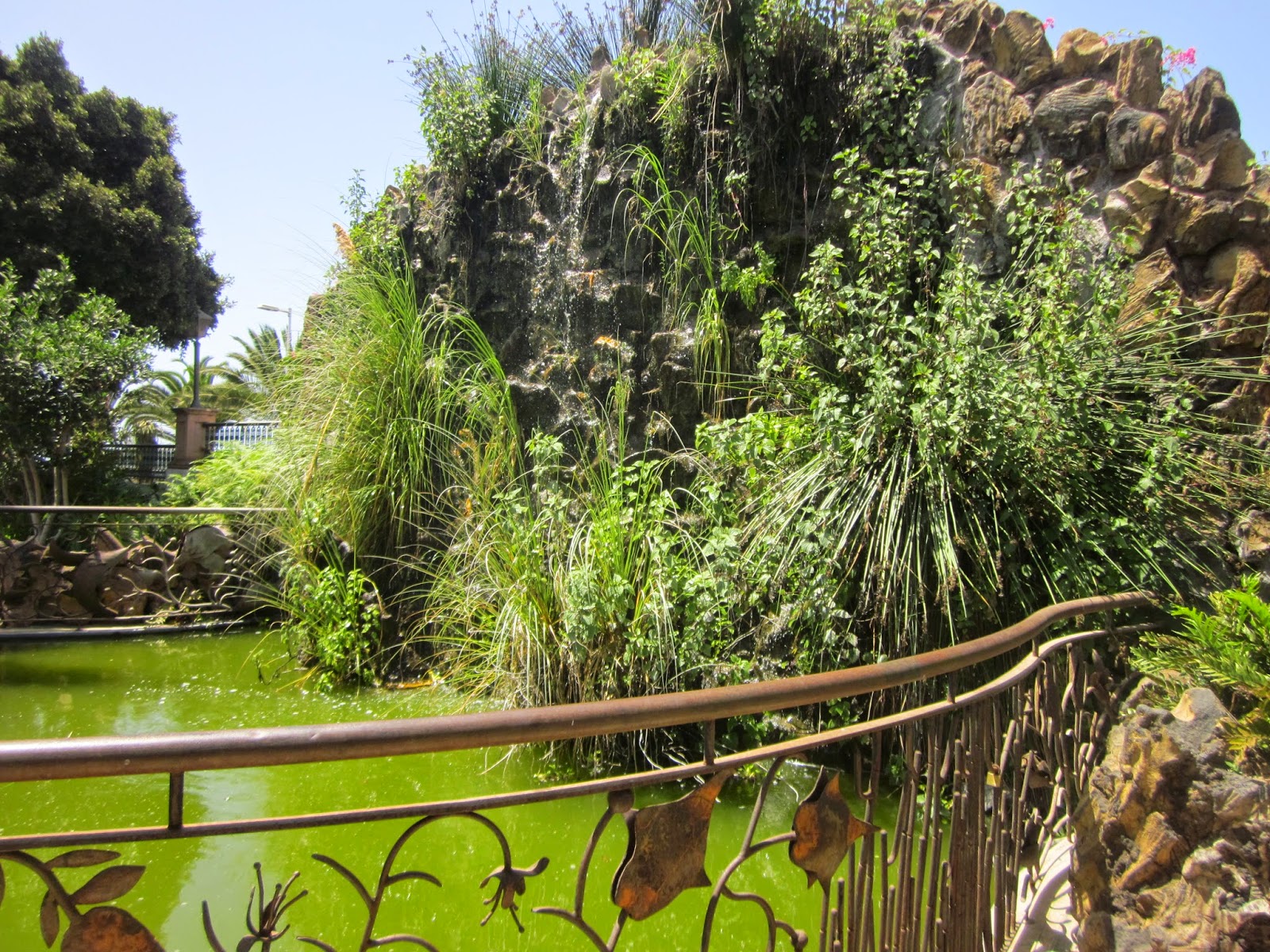
Parque Los Llanos La Palma

Los Llanos La Palma

Park Los Llanos La Palma

Parque Los Llanos La Palma
Just to continue the fun, the park leads straight onto another park, albeit with a rather different theme. This is where you can wonder along geometrically pleasing paths that line precise quadrants of grass. Young children are now let off the leash and can run along the paths in full sight of parents, perhaps pausing to delight, as did we, at the sight of a mother hen with baby chicks picking at the grass (by the way, when translated into a word, Spanish chickens say 'peep peep' and not 'cheep cheep.') But of course there is also the added attraction of a children's play area.  There is also static exercise equipment for adults too. Or you can of course just sit, have a picnic and enjoy the tranquil surroundings. 
Park Los Llanos

Park Los Llanos La PalmaBut this is not a new park, no, in fact it goes back to 1958 when it was first inaugurated following the idea to create a space of about 6000 m2 of wooded city park. In 1962 'improvements and additions were made to the park including a space dedicated to wildlife: ducks, monkeys, pigeons, peacocks etc.' (Elapuron)
In more recent times, it was closed to undergo a complete refurbishment (if one can 'refurbish' a park) and re-opened again in 2010. 

Opening hours are 9.00 to 21.00 hours, from Tuesday to Sunday.

Saturday, 30 August 2014

Santa Cruz de la Palma Museum - Museo Insular

Tucked away in the corner of a plaza which itself lies tucked away behind the main street of Santa Cruz lies the biggest museum on La Palma. It’s vast, I kid you not. As the discreet banner outside declares, it has ‘paintings, natural sciences and ethnography’ although it doesn’t mention the half of it and  there is no hint as to the scale of it all.
The museum is housed in the old Franciscan 16/17th century convent which borders the Plaza Santo Domingo. The entrance in the far corner is as discreet as the museum itself. It’s a vast and beautiful building and you’re going to be torn by all the different categories of exhibits.First up is the long hall which is filled with filled animals, by which I mean a taxidermy delight. And whilst I’m not really into looking at stuffed animals I still found it really interesting to see where the land animals and sea creatures had been found – either on La Palma or one of the nearby islands. So it’s a bit of history, geography and biology all rolled into one.


Then there is a room filled with scale models of various sailing vessels associated with the history of La Palma along with marine implements of the time. Open exhibits include hugh scales used for weighing bales.

That leads nicely on to the hand tools used in agriculture. I had no idea there could be so many different types.Then a room filled with huge looms. And talking about moving between rooms, even the open corridors of the open quadrant will stun you – wide wooden floorboards of tea wood harvested from the pine forests of La Palma.


But there are still surprises to go such as the guitar room. Not quite what we were expecting but of course it’s not a room of ordinary guitars – it’s a room of guitars through the ages including a Timple (small 5-string guitar like a Ukulele) made from a cigar box labelled as ‘Santa Cruz cigars.’ Ah, the ever-inventive and resourceful Palmerans.
Opening times:
Monday to Saturday 10.00 hrs to 20.00 hrs.
Sunday 10.00 hrs to 14.00 hrs
July, August, September Monday to Saturday only 10.00 hrs to 19.30 hrs
Fiesta – closed
Last entry is 30 minutes before closure
Price 4€ per person

Wednesday, 30 July 2014

Embroidery of La Palma

Before I came to live on La Palma, I had no idea that the island was famous for its embroidery. Well OK, I didn't know that La Palma actually existed but that's another story ...
In fact, La Palma has a tradition of many handicrafts including not just embroidery but also silk production (going back to the 16th century), basket making and cigars (which Winston Churchill smoked and highly rated).  And they are all still hand made today. Out of all the crafts though embroidery has always been an important source of income for many families. But it wasn't just an income, it was a way to add the personal touch to traditional dress or tablecloths and even church vestments.
Nowadays, you can find all sorts of embroidered items from bookmarks, to drink mats, mobile phone holders and of course wonderful pieces to hang on the wall.
I am lucky though in that I live next door to a master craftswoman - an instructor of embroidery. Every time I pop in to see Carmen I can almost guarantee she'll be sat working away at her embroidery. From small items to a huge tablecloth, she never tires of it. 'I just love it!' she tells me.
So how much does it cost?
The embroidered roses above will cost around 30€ to 50€ - the frames are extra and normally you would go to a framing specialist who will stretch the cloth so there are no unsightly creases. But for a small item, you can buy nice pieces for just a few Euros.
The great thing is that they make an ideal present to take home from your holiday as they won't break, they don't take up any room and they are actually from La Palma. Beware of buying machine-made imitations though. Of course they are cheaper but they certainly aren't anything to do with the tradition of La Palma and it really is worth going for the real deal.
Also, they are machine washable. Just remember to iron on the reverse.
Carmen's embroidery shop isn't open any more as she's retired although she does make special pieces to order. But if you are in the area of Mazo, do pop in to the Casa Roja (Red House) museum and have a look at their intricate embroideries. It's right in the village centre and the opening hours are Mon-Fri 10:00-14:00/15:00-18:00 and Sat 11:00-18:00 and Sun 10:00-14:00.
You will also find embroidery to buy in some of the 'Artesenia' (Handicraft) shops or souvenir shops and when there is a local craft market too.

Monday, 30 June 2014

Fun on the finca

Yes, we've reached that time of year when it's a little quieter on La Palma with regard to tourism.
This often surprises people as they tend to think that the summer is peak season in the Canaries, but no, the busiest period on La Palma is the winter.  The reason is simple - in January, February and March when the rest of Europe can be particularly cold, people head to the Canaries for the winter sun.
January in Tazacorte
So it follows that some businesses can take a short break (or take stock at least!) and a few restaurants close for their annual holiday for a week or two sometime in May, June or July. And we did a little bit the same this year although never actually closing our doors. But it's certainly a good opportunity to take time out and make a visit to the UK (or other Canarian island). This time, our lovely casita guests were kind enough to look after the finca while we went to Fuerteventura. And what do we find ourselves doing - walking of course!
As it happens, in May and June it's also a turn around in nature. It's a time when the spring flowers finish and need trimming or tidying up and also it's all change with the vegetables on the finca. The winter crops have finished and we can harvest the potatoes, cabbage, leeks and onions. Did I mention onions? I think we went a bit overboard on the onions!!
And in their place, the sweetcorn, beans and tomatoes are sown and planted up. With any luck the outside of the house will get painted and the wooden decking and garden furniture will get a spruce up.
Holiday? Who said that!
Finca Franceses